Showing posts with label Peru. Show all posts

Monday, 7 September 2009

World’s largest fishery angles for sustainability


Lima, Peru: Peruvian anchovy fishers – who pull in 10 percent of the total fish catch in the world – for the first time will be independently monitored, ensuring the sustainability of stocks.


Peruvian anchovy (Engraulis ringens) is a major Peruvian export, reaching more than U.S. $ 1.7 billion in 2008, equivalent to 70 percent of national fish exports for the entire country. Although the government in past years had gradually improved the management of anchovy stocks by creating standards and quotas, this new monitoring system will greatly bolster those efforts.


The Peruvian government earlier this month signed an agreement which formalized the establishment of the first Peruvian Observatory to regulate its fishing industry, run by universities Cayetano Heredia and del Pacifico, The Nature Conservancy (TNC), WWF and the Instituto del Mar Peruano (IMARPE). This observatory aims to implement a monitoring system that will strengthen and complement the technical capabilities of the government to ensure sustainable management anchovy stocks.


“I’m sure that with this development we’ll have the world’s best fishery and not just the largest," said the Minister of Production of Peru, Dr. Mercedes Araoz.


By providing free access to fisheries data for the scientific community and, the general public, the new Observatory will better allow for the implementation and enforcement of the “maximum established catch per boat” set previously by the government. Furthermore, it will help to assess the potential impacts of industrial fisheries and recommend best practices and strengthen the sector to improve fisheries management, ensuring the resilience of the anchovy population and the sustainability of the marine ecosystem of
Peru.


"This puts Peru at the forefront of the world’s fisheries because it not only shares the information of the largest fishery on the planet, but it takes an important step towards sustainability and possible certification, and even generates inputs for the conservation of Humboldt’s marine ecosystem facing climate change", said Michael Valqui, Director of WWF Peru's Marine Program.


In addition to driving this initiative with the del Pacifico and Cayetano Heredia local universities and TNC, WWF Peru is currently contributing to the design and implementation of the operating system of the Observatory which will eventually work as an online platform with accurate technical information on the implementation of quotas, seasons and other aspects relevant to this activity. Also, the group will work in coordination with IMARPE to ensure maximum benefit from this system that, since it addresses the issue of transparency in the fishing industry, constitutes a necessary step on the path towards an eventual certification of Peruvian anchovy fishery by the Marine Stewardship Council (
MSC).

Thursday, 9 April 2009

Ex-President Convicted of Death Squad Killings

Human Rights Watch Weekly Digest

April 9th, 2009

Dear supporters,

As I'm sure you have seen in recent news, the former president of Peru, Alberto Fujimori, was found guilty by the Peruvian Supreme Court on charges involving serious human rights violations. After years of evading justice, Fujimori is finally being held accountable for some of his crimes.

For a decade, from 1990 to 2000, the Fujimori government used bribery, extortion, and intimidation to concentrate power in the presidency, subverting the democratic process and eliminating checks on government abuses. In the trial, Fujimori was convicted of the killings of 25 people in two massacres in 1991 and 1992, carried out by a specialized squad of military intelligence officers. Human Rights Watch Senior Researcher Maria McFarland was in the courtroom for the ruling's announcement.

In 2005, Human Rights Watch released a report that documented Fujimori's abuses and presented evidence linking him to the perpetrators, helping build a case against him. We are proud that our report contributed to this important verdict. The court's ruling is important because it demonstrates the crucial role an independent national tribunal can play in addressing past human rights abuses, even against a former head of state.

The landmark decision is part of a global trend of increasing accountability for former heads of state and other high-level abusers. Human Rights Watch is playing a leading role in seeing this change through, with the help of our supporters. And make no mistake – it is your support that enables us to expose the truth and apply pressure, bringing about the kind of deep rooted change that promotes global justice.

Sincerely,
Kenneth Roth
Executive Director

Peru: Fujimori Verdict a Rights Victory
Q & A: Trial of Former President Alberto Fujimori of Peru

Report Cover @ HRW 2009


Support Human Rights Watch

Tuesday, 7 April 2009

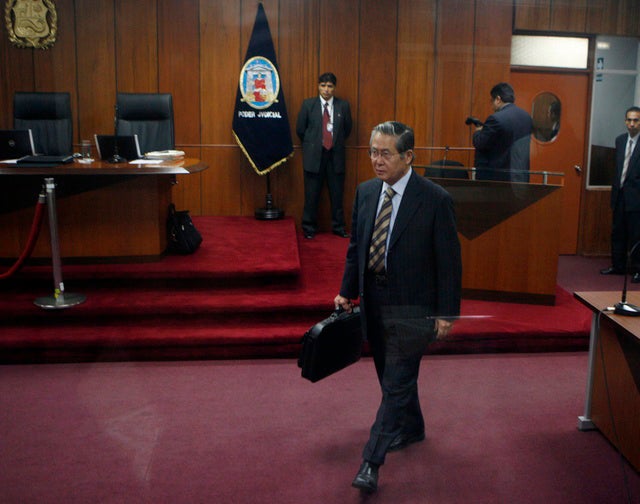
Peru: Fujimori Verdict a Rights Victory

2008_Peru_FujimoriTrial.jpg
Former President's Trial Likely to Advance Justice, Rule of Law
Today's conviction of Alberto Fujimori, former president of Peru, is a major advance for human rights accountability in the region and beyond, Human Rights Watch said today.

A three-judge panel of the Peruvian Supreme Court found Fujimori guilty on charges involving serious human rights violations.

"After years of evading justice, Fujimori is finally being held to account for some of his crimes," said Maria McFarland, senior Americas researcher at Human Rights Watch, who was in the courtroom for the ruling's announcement. "With this ruling, and its exemplary performance during the trial, the Peruvian court has shown the world that even former heads of state cannot expect to get away with serious crimes."

Human Rights Watch pointed out that today's landmark decision fits within a global trend of increasing accountability for former heads of state. But it stands out because in contrast to many other situations, Peru's national court system demonstrated the will, capacity, and independence to try its former president.

The ruling came after a lengthy televised trial, which Human Rights Watch said was respectful of due process guarantees and consistent with international standards on fair trial.

Fujimori was convicted of the killings of 25 people in two separate massacres, in 1991 and 1992, and the kidnappings of Gustavo Gorriti, a journalist, and Samuel Dyer, a businessman, in 1992. The massacres were carried out by the Colina unit, a specialized squad of military intelligence officers.

In its 2005 report, "Probable Cause: Evidence Implicating Fujimori", Human Rights Watch detailed the substantial evidence then available linking Fujimori to the Colina unit and its activities. The evidence included extensive official documentation and testimony showing that the Colina unit was not a rogue operation, but rather existed as a formal structure within the Army. Its members received resources and logistical support from the highest levels of the Army and the National Intelligence Service, which were completely under Fujimori's control.

During the trial, additional evidence surfaced showing that the killings formed part of a counterinsurgency strategy that Fujimori established and carried out through the country's intelligence services.

Human Rights Watch noted that today's ruling takes on added significance because of Peru's history of authoritarianism and weak rule of law. For a decade, the Fujimori government used bribery, extortion, and intimidation to concentrate power in the presidency, subverting the democratic process and eliminating normal checks by the judiciary, legislature, and media on government abuses. Fujimori is to be tried separately on multiple corruption charges, which are also detailed in "Probable Cause."

"Just a few years ago, Fujimori had near-total control of Peru's judiciary," said McFarland. "This court's ruling is important not only because of its content, but also because it demonstrates the crucial role an independent tribunal can play in addressing past abuses and shoring up the rule of law."

Today's conviction is subject to appeal before the Supreme Court.

"We would like to believe that the court will continue to show the same transparency and impartiality it has demonstrated during the trial phase," said McFarland. "If it does, we're confident the verdict will stand."